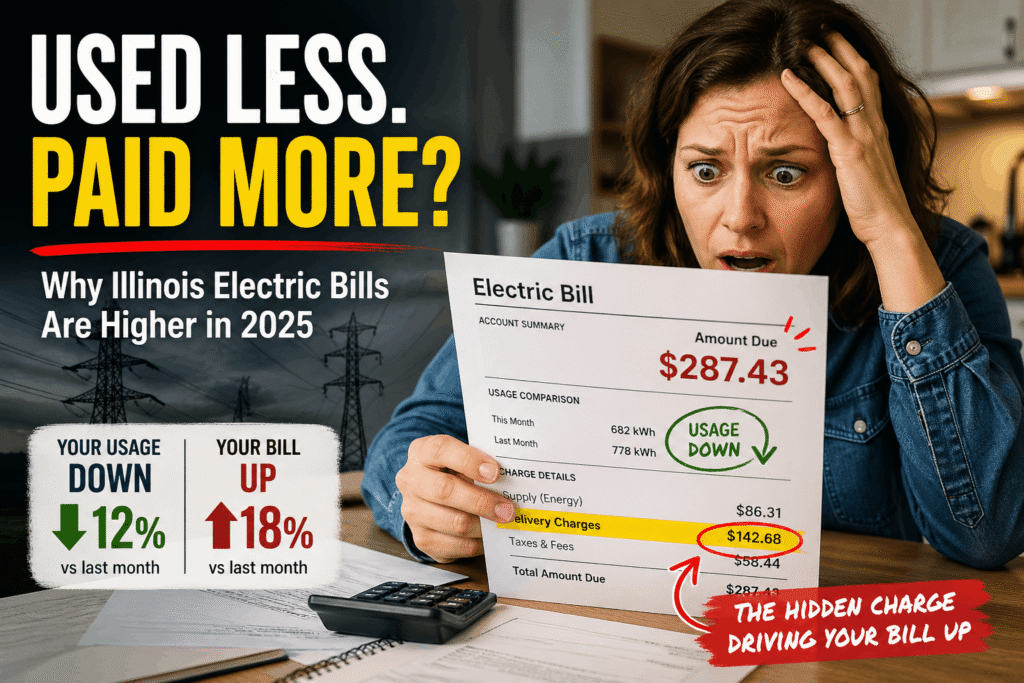
You cut back on the AC. You switched off lights you weren’t using. You even did the laundry at midnight. And yet — your ComEd or Ameren bill still came in higher than last month. If you’re staring at that number wondering what went wrong, you’re not alone. Thousands of Illinois homeowners are asking the exact same question, and the answer lives in a part of your bill most people never bother to read: the delivery fee.
This article breaks down exactly what’s happening to electricity bills across Illinois right now, why usage has almost nothing to do with the increase, and what you can actually do about it — including the option that’s turning into a serious long-term fix for homeowners who are done feeling powerless every time their bill arrives.
What Is a ‘Delivery Fee’ — And Why Is It Eating Your Bill?
Most Illinois residents think their electric bill is one thing. It isn’t. Your bill has two completely separate parts: the supply charge (the cost of the electricity itself) and the delivery charge (what you pay to have that electricity transported to your home through the grid).
The supply charge is the part that fluctuates with usage. Use less electricity, pay less for supply. Simple enough. But the delivery fee? That’s a fixed and formula-based charge that the Illinois Commerce Commission (ICC) approves — and it doesn’t move based on how many kilowatt-hours you consume. The ICC regulates delivery rates for ComEd and Ameren, while supply rates are set by wholesale market auctions entirely outside state control.
So when delivery rates go up — even if you didn’t use a single extra watt — your bill goes up. That’s the trap a lot of Illinois families have walked into this spring.
The Numbers Behind the Spike: What Changed and When
This isn’t a small blip. Starting January 1, 2025, the ICC approved a $606 million increase in ComEd’s delivery rates. For a single-family home without electric heat, the monthly fixed charge jumped from $13.18 to $15.45, and the per-kWh delivery rate climbed from 4.981 cents to 6.062 cents. That alone added several dollars to monthly bills before any supply charges even entered the picture.
Then came June 2025. A 2024 capacity auction run by PJM Interconnection — the grid operator covering northern Illinois — produced results that stunned energy analysts. The cost of reserve power capacity jumped roughly 830 percent, from $28.92 per megawatt-day to a record $269.92 per megawatt-day. According to Utility Dive, the total cost to consumers from that single auction leaped from $2.2 billion to $14.7 billion.
For Ameren customers downstate, a similar story played out through MISO auctions. Ameren customers saw their supply rate jump from around 8 cents per kWh to 12 cents — an 18 to 22 percent total bill increase per the utility’s own estimates. For all Illinois power customers combined, residential costs rose more than 14 percent from June 2024 to June 2025, according to state data.
Quick Fact: ComEd estimates the supply rate spike alone costs the average residential customer about $10.60 more per month. After a summer heat wave in 2025, some customers reported triple-digit jumps in their monthly bills.
Why the Grid Got So Expensive: The ‘Perfect Storm’ Nobody Is Talking About
The spike in capacity costs isn’t random. Several forces collided at once, and Illinois got caught in the crossfire.
1. Coal and Gas Plants Are Closing Faster Than New Generation Comes Online
Illinois’ Climate and Equitable Jobs Act (CEJA), signed in 2021, set aggressive timelines for phasing out fossil fuel generation. Some coal plants have already shuttered — four closed in 2022 alone. While that’s good for long-term climate goals, the renewable capacity needed to replace them hasn’t come online fast enough. Delays in permitting, interconnection, and siting have left a real gap in available baseload power, and the capacity auction prices reflect exactly that gap.
2. Data Centers and AI Are Drinking the Grid Dry
This one surprises people. The explosion in data centers, cloud computing, and AI infrastructure has created a surge in industrial electricity demand that the grid simply wasn’t built for at this scale. That demand is competing directly with residential customers for the same pool of reserve capacity — and driving prices up for everyone.
3. Federal Tax Credits for Renewables Are Now Uncertain
The federal policy environment shifted significantly in 2025. The One Big Beautiful Bill Act, signed into law on July 4, 2025, compressed the window for renewable energy tax credits. The residential Investment Tax Credit (ITC) — which had been a 30% credit for solar installations under the Inflation Reduction Act — is now expired for residential purchases installed after December 31, 2025. That creates long-term pressure on the renewable build-out that could keep grid costs elevated for years.
Congressman Raja Krishnamoorthi put it plainly: ending tax credits that support renewable projects hampers our ability to bring lower-cost power to Americans. Ameren itself has expressed concern about the long-term effect of reduced federal renewable support on grid stability and consumer prices.
What the Utilities Say and What They Aren’t Telling You
Both ComEd and Ameren are quick to point out that they pass supply costs through to consumers with no markup and no profit. That’s technically true. ComEd’s revenue comes from delivery charges — not from the supply spike. So yes, the utility itself isn’t pocketing extra money from your pain at the meter.
But here’s what doesn’t get said as often: the delivery rate hikes are a different story entirely. ComEd absolutely does earn revenue from those delivery charges, and CUB (the Citizens Utility Board) has been actively challenging delivery rate increases before the ICC on behalf of consumers for years. The supply spike and the delivery increase are two separate events — and both landed on Illinois ratepayers in the same short window.
Illinois does have one bright spot buried in the CEJA legislation: the Carbon Free Energy Resource Adjustment (CFERA). When supply prices exceed a certain threshold — as they have — the mechanism flips to a bill credit for standard residential customers. That credit was roughly 1.7 cents per kWh in summer 2025, which softened the blow somewhat. But note: net metering solar customers operate on a reversed formula, receiving a charge rather than a credit under this provision.
What Can You Actually Do About It Right Now?
Cutting usage helps with the supply portion of your bill, but as we’ve established, it does almost nothing about the delivery fee. That said, here are real options Illinois residents have available:
Switch Your Electricity Supplier
ComEd and Ameren customers have the option to purchase electricity supply through an alternative retail electric supplier, still delivered by their main utility. These suppliers sometimes offer fixed rates that can insulate you from market volatility. The state runs PlugInIllinois.org specifically to help consumers compare options.
Enroll in Budget Billing
Budget billing spreads your costs evenly across 12 months based on estimated annual usage. It won’t save you money overall, but it prevents bill shock during peak months and makes household budgeting easier.
Apply for Utility Assistance Programs
Both ComEd and Ameren offer financial assistance programs for income-eligible customers. If your household income qualifies, these programs can provide direct financial relief or payment flexibility. Contact your utility directly to ask what’s available.
The Long Game: Why More Illinois Homeowners Are Going Solar Right Now
Budget billing and supplier switching are useful. But they don’t change the fundamental reality: you remain entirely at the mercy of the grid. Every capacity auction, every fossil fuel plant closure, every data center that goes up in the Midwest can send your bill in a direction you can’t control.
That’s why the spike in 2025 has driven a surge in homeowner interest in rooftop solar across Illinois. The math has shifted significantly. When your delivery fee goes up regardless of your usage, the appeal of generating your own electricity — and using net metering or battery storage to reduce grid dependence — becomes much more concrete.
The Illinois Solar Incentive Picture in 2026: What’s Left and What’s Changed
This is where a lot of people get confused — particularly after recent news about federal tax credit changes. So let’s be direct about where things stand.
Federal Investment Tax Credit (ITC): The Window Closed December 31, 2025
The 30% residential Residential Clean Energy Credit under IRS Section 25D is no longer available for systems installed after December 31, 2025. Homeowners who completed installations before that deadline captured a credit worth an average of $6,750 on a typical Illinois solar system. That window has now closed for owner-purchased residential systems though third-party ownership models like leases and PPAs can still access commercial credits under Section 48E through 2027.
This shift matters a lot for how you evaluate solar financing in 2026. The incentive landscape is different than it was a year ago, which makes working with a tax professional who understands solar-specific rules essential not optional.
Illinois Shines (Adjustable Block Program): Still Available and Meaningful
Illinois Shines — the state’s SREC-based incentive program run by the Illinois Power Agency — remains active in 2026. The program provides an upfront lump-sum payment based on the projected solar energy your system will produce over 15 years. For an average 7 to 8 kW rooftop system, that payment typically falls in the $7,000 to $11,000 range depending on block pricing and your utility territory.
The 2025-2026 program prices reflect a roughly 10% decrease from 2024 for systems under 25 kW, but the program remains the most significant state-level incentive Illinois homeowners can access. You must work with an Approved Vendor under the Illinois Shines program your installer needs to be certified to access this incentive on your behalf.
Net Metering Under NEM 2.0: The Rules Changed January 1, 2025
Illinois moved to a supply-only net metering model for new solar installations starting January 1, 2025. Under the old rules, excess solar generation sent to the grid earned you credits that could offset your entire bill — supply, delivery, and taxes. Under NEM 2.0, those credits only apply to the supply portion of your bill.
Given that delivery fees now make up a growing share of your total bill, this change significantly affects how much you can zero out. For homeowners going solar in 2026, this is a strong argument for pairing panels with battery storage — keeping more of your solar generation on-site means you consume it yourself rather than exporting it at reduced value.
If you installed solar before January 1, 2025, you’re grandfathered into the old full retail net metering rules for the life of your system. That’s a meaningful advantage for earlier adopters.
Property Tax Exemption: Still Fully Active
Illinois still provides a 100% property tax exemption on the added value a solar installation brings to your home. Since solar panels typically increase property value by 5 to 10%, this exemption saves homeowners hundreds of dollars annually in property taxes. You file a PTAX-330 form with your county assessor to claim it.
Utility Rebates for Smart Inverters
Both ComEd and Ameren offer $300 per kW of solar capacity for systems installed with a grid-communicating ‘smart’ inverter. On an 8 kW system, that’s $2,400 in additional rebates. This program has become more commonly used since Illinois moved away from full-rate net metering, making these rebates more attractive relative to the forgone legacy benefits.
Making Sense of the Total Picture: Does Solar Still Pencil Out in 2026?
Here’s the honest answer: it depends on your specific situation — your roof, your usage, your tax position, and which financing path you take. But for many Illinois homeowners, particularly those sitting on ComEd or Ameren service territory, the math has improved in solar’s favor because of the delivery fee increases, not despite them.
Consider what you’re paying on the grid side. If your monthly bill has climbed $80 to $150 higher than it was two years ago — partly from delivery fee hikes, partly from the supply capacity spike — the breakeven point on solar gets shorter every month those bills stay elevated. The average Illinois solar installation before incentives runs around $39,000 for a 12 to 13 kW system. After Illinois Shines payments, utility rebates, and any applicable commercial credits on leased systems, that cost can drop substantially.
EnergySage data from April 2026 shows Illinois solar averaging $3.07 per watt — with estimated 25-year savings around $24,936 for a cash purchase. That’s before factoring in the bill environment today, where grid electricity in northern Illinois is running roughly 47% higher than it was just a year ago for October pricing.
One Step Most Homeowners Skip And It Costs Them Thousands
Most Illinois homeowners who go solar focus almost entirely on the installation side. They pick a panel brand, compare quotes, worry about the roof angle. What a surprising number miss is the tax side — and that’s where real money gets left on the table.
Even with the residential ITC expired for 2026 installs, the tax implications of going solar are substantial and genuinely complex. SREC payments, the treatment of utility rebates, depreciation rules for business owners with commercial systems, the interaction between solar and your overall tax liability — these aren’t questions a typical CPA handles every day.
That’s where working with specialists who live in this intersection makes a difference. Solar Tax Pros focuses specifically on the tax side of solar investment — helping homeowners and businesses understand exactly what they can and can’t claim, structure their financing correctly to maximize what’s available under current law, and avoid the audit triggers that generic solar tax advice tends to create. Their work complements what a good installer does — and for people who are serious about treating solar as the financial decision it actually is, that layer of expertise matters.
If you’re weighing solar in Illinois right now, you want your installer and your tax guidance coming from people who know what they’re doing. Don’t let the tax piece be an afterthought.
How Orphan Annie Solar Helps Illinois Homeowners Get Off the Grid Roller Coaster
If you’re an Illinois homeowner ready to stop watching your electric bill like a stock ticker, Orphan Annie Solar works directly with residential customers across the state to design solar systems that make sense for your home, your usage, and your financial situation including the new net metering environment and the current incentive landscape.
The delivery fee isn’t going away. Capacity auctions will happen again. Data center demand isn’t slowing down. The grid will keep being the grid. The question is how much longer you want to pay for all of that without doing something about it. Your roof might be your best hedge.
Frequently Asked Questions
Why did my ComEd bill go up even though I used less electricity?
The delivery fee is a fixed charge approved by the Illinois Commerce Commission that doesn’t change based on your usage. A $606 million delivery rate increase took effect January 1, 2025, raising the fixed monthly charge and the per-kWh delivery rate. Even if you cut your consumption, the delivery portion of your bill went up.
What caused the electricity capacity spike in Illinois in 2025?
A 2024 PJM capacity auction produced a record price jump of around 830 percent for ComEd territory. Contributing factors included the retirement of coal and gas plants without enough replacement renewable capacity online, surging electricity demand from data centers and AI infrastructure, and delays in new generation interconnection.
Is the 30% federal solar tax credit still available in Illinois?
No, not for residential owner-purchases. The Section 25D residential Investment Tax Credit expired for systems installed after December 31, 2025. Homeowners who signed contracts and completed installation before that date remain eligible. Third-party ownership models like leases and PPAs can still access the commercial Section 48E credit through 2027.
What solar incentives are still available in Illinois in 2026?
Illinois Shines (the Adjustable Block Program for SREC payments) remains active, typically worth $7,000 to $11,000 depending on system size and block. The property tax exemption for solar systems is still fully in effect. ComEd and Ameren each offer $300 per kW rebates for smart inverter installations. Net metering continues under the new NEM 2.0 supply-only model for new installations.
Will Illinois electricity rates go back down?
Ameren rates dropped back to around 8 cents per kWh in October 2025 as seasonal demand eased. Supply rates can move up and down with each auction and season. But delivery fees — the fixed infrastructure charges — don’t typically reverse once the ICC approves an increase. The structural pressures on Illinois grid capacity are unlikely to resolve quickly, meaning elevated rates in some form are likely for the foreseeable future.
The Bottom Line
Your April electric bill is higher because two things hit at once: a massive ICC-approved delivery rate increase and a record-breaking capacity auction spike that had nothing to do with how much power you used. Both are structural issues baked into how Illinois prices electricity — and both are going to be part of the conversation for years to come.
The good news is that Illinois still has a meaningful solar incentive framework even after the federal ITC expired. Illinois Shines payments, property tax exemptions, and utility rebates still exist. The net metering rules changed, but the underlying value of producing your own electricity — and the protection it gives you against delivery fees — has actually grown stronger as grid costs have climbed.
Whether solar is right for you comes down to your specific situation. But if you’ve been thinking about it and keeping an eye on your electric bill, the conversation worth having is happening now — not next year.
About Orphan Annie Solar
Orphan Annie Solar helps Illinois homeowners navigate the solar process from evaluation to installation, working to maximize available state and utility incentives for every customer. For homeowners who want expert guidance on the tax side of going solar, Solar Tax Pros solartaxpros.com provides specialized tax advisory services focused exclusively on solar energy investments.