
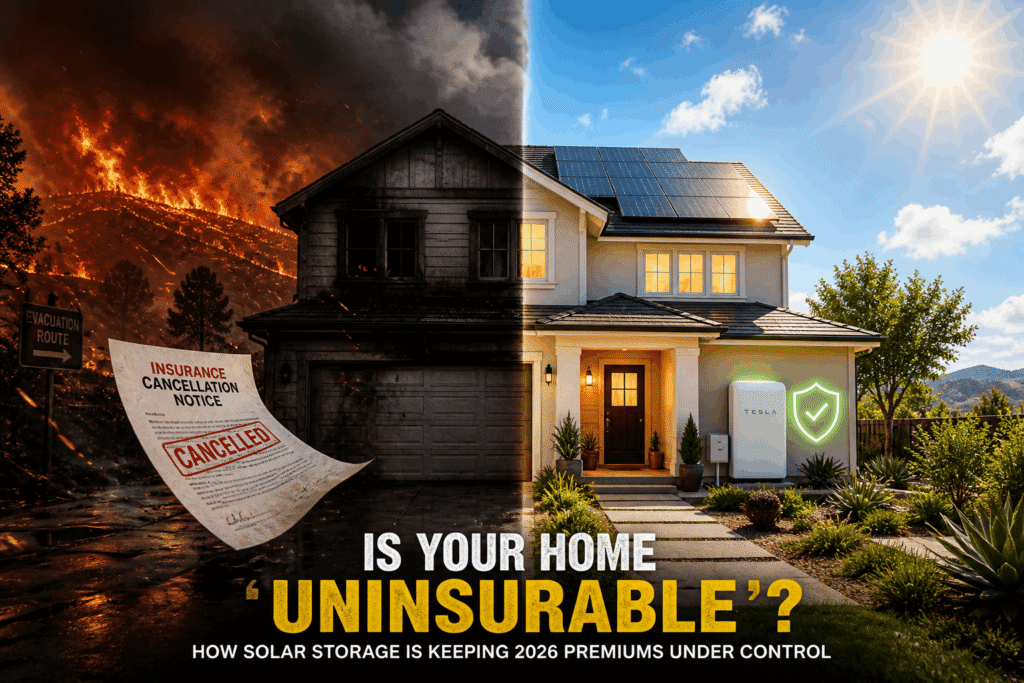
If you’ve opened a homeowners insurance renewal letter in the last twelve months and felt your stomach drop, you’re not alone. Across California, Florida, Texas, Georgia, and a growing list of other states, insurers are doing something they almost never used to do: walking away entirely. Not raising your rates — pulling coverage. Leaving homeowners scrambling for the state insurer of last resort at double the premium and half the protection.
This isn’t a temporary blip. According to research from the Natural Resources Defense Council, the United States risks becoming “an uninsurable country” if current climate and development trends continue. But here’s what the doom-and-gloom headlines tend to skip: a growing number of homeowners are actively outrunning this crisis — not by moving, and not by just absorbing the higher bills. They’re doing it with solar and battery storage.
And the financial case, even after federal tax credits changed dramatically in 2026, is stronger than most people realize.
The Insurance Crisis Is Real — And It’s Getting Personal
Let’s start with some numbers that are hard to ignore. The average cost of homeowners insurance in the United States has climbed roughly 30 to 40 percent over the last five years — and that’s the national average. In states like Florida, where the market has been shaken to its core by successive hurricanes, average premiums have risen by over $1,400 per household since 2020 alone. California homeowners who can still find private coverage are often paying two or three times what they paid just a few years ago.
The numbers behind those figures tell an even harder story. Insured losses from natural disasters in the U.S. averaged $100 billion per year between 2023 and 2025, up from roughly $15 billion annually a decade earlier. That’s not a rounding error — it’s a structural shift in how risky American real estate has become. And insurers are responding accordingly.
In California alone, roughly 1 in 5 homes in the highest-risk fire zones lost coverage between 2019 and 2024. California’s FAIR plan — the state’s backstop insurer — grew from covering around 210,000 homes in 2020 to more than 463,000 by 2024, with total exposure exceeding $450 billion. After the devastating 2025 LA wildfires, FAIR plan claims approached nearly $5 billion in a single event.
Georgia is seeing projected 10 percent increases in 2026 following 9 percent in 2025. North Carolina, still reeling from Hurricane Helene, faces another round of hikes. The pattern repeats in state after state: weather gets worse, losses pile up, insurers raise rates or leave, homeowners get squeezed.
Why Solar + Battery Storage Changes Your Risk Profile — Not Just Your Electric Bill
Here’s where most solar conversations get stuck: people think about panels in terms of monthly savings on electricity. That’s real and worthwhile. But in 2026, the more significant conversation is about risk — specifically, the kind of risk that insurers price into your premium.
When you pair solar panels with a battery storage system, you’re doing something that plain panels can’t: you’re making your home energy-independent during the events that cause the most damage. A home with battery backup doesn’t need to rely on utility power during a wildfire evacuation window, a hurricane approach, or an ice storm. It can power sump pumps, maintain refrigeration for medications, keep communications up, and reduce fire risk from downed power lines.
That’s not just a comfort factor. Some insurers — particularly those operating in wildfire-adjacent markets — are beginning to incorporate “home hardening” measures into their underwriting assessments. A solar-plus-storage system that reduces dependence on the grid during high-risk periods is increasingly seen as a risk mitigation feature, similar to ember-resistant vents, metal roofing, or defensible landscaping.
The 2026 battery market has also matured considerably on safety. Insurers who evaluate residential storage now look closely at battery chemistry (Lithium Iron Phosphate, or LFP, carries significantly lower thermal risk than older chemistries), Battery Management System certifications, installation standards, and thermal runaway protocols. A well-specified, properly installed LFP system today is a very different risk proposition than early-generation storage from five or six years ago.
The Tax Credit Landscape in 2026: What Actually Changed and What Remains
It would be wrong to write about solar and battery storage in 2026 without addressing the elephant in the room: the federal tax credit situation has shifted significantly, and homeowners deserve a straight answer rather than vague optimism.
The short version: the 30% Residential Clean Energy Credit (Section 25D) was terminated by legislation signed in July 2025, effective December 31, 2025. If you bought and installed a qualifying solar or battery system before that date, you can still claim the credit on your 2025 federal tax return — and it carries forward to future tax years if your liability doesn’t cover it all in one year.
For systems installed in 2026 and beyond under direct ownership, that federal benefit no longer applies. On a typical combined solar-plus-storage system worth $35,000–$45,000, that’s a meaningful difference in out-of-pocket cost.
However, the picture isn’t as bleak as some coverage suggests:
Leased and PPA systems still qualify for commercial investment tax credits (Section 48E) through 2032, and installers pass those savings to homeowners through lower monthly payments. A lease-to-own or prepaid lease structure, which lets you eventually take title to the system, is becoming increasingly common.
State-level incentives remain active and in some cases more valuable than ever. California, Connecticut, New York, and Colorado all offer battery rebates ranging from $5,000 to $16,000 depending on program specifics.
Homeowners who use part of their property for legitimate business purposes — a home office, a rental unit, business-registered vehicle charging — may still qualify for business-use incentives in 2026, with some structures allowing reservations through July 4, 2026 for projects built as late as 2030.
The critical point is that navigating this properly requires looking at your specific tax situation, not just a generic checklist. This is exactly the kind of complexity where working with someone who understands solar tax strategies — not just solar installation — pays off. Firms like Solar Tax Pros focus specifically on the tax side of residential and commercial solar decisions — helping homeowners understand which incentives still apply to their situation, how to structure an installation for maximum benefit, and whether credits from 2025 systems can still be captured going forward. That kind of specialized guidance has become considerably more valuable in a post-Section-25D landscape.
Battery Storage in 2026: What You’re Actually Buying
If your mental image of home battery storage is a clunky, expensive unit that might catch fire — it’s time for an update. The 2026 residential battery market looks very different from even two or three years ago.
A typical 13.5 kWh residential system — the kind that keeps your essentials running through a standard overnight outage or a grid disruption — runs approximately $15,000–$18,000 installed before any state or utility incentives. Lithium Iron Phosphate chemistry now dominates the market, and for good reason: these batteries operate at a far safer temperature threshold than earlier nickel-manganese-cobalt designs. LFP systems from reputable manufacturers come with 10-year warranties as standard, and real-world performance data shows them regularly reaching 15–20 years of useful life.
Roughly 40% of new residential solar installations in the U.S. now include battery storage — and in high-demand markets like California, Arizona, and Texas, that figure exceeds 60%. The growth isn’t sentiment-driven. It’s driven by real-world reliability needs: time-of-use electricity pricing, increasingly unreliable grid performance, and the hard math of what an extended outage costs a household.
For homeowners in high-risk insurance zones, adding storage to a solar system does something else: it gives insurers a documented story about home resilience that plain panels can’t tell. A monitored, certified battery system with a functioning emergency protocol is a paper trail that can matter during an underwriting review.
The Real Premium Calculation: Electricity Rates Are the Other Half of the Equation
When people ask whether solar still makes sense in 2026 without the federal tax credit, they often frame it as a binary: “Is the math still good?” But the math depends heavily on what you’re comparing against.
Electricity rates in the U.S. have increased roughly 8% annually since 2018 — effectively doubling every 7 to 9 years at that pace. Some markets are already extreme: SDG&E in Southern California has reached peak rates above $0.91/kWh for EV time-of-use customers. Even at more moderate national averages, a household locking in today’s solar generation cost protects itself against rate increases that have proven stubbornly persistent across both Republican and Democratic administrations.
Battery storage adds another layer: the ability to store cheap daytime solar generation and discharge it during peak-rate evening hours. In markets with time-of-use billing — which increasingly covers much of the country — this can shave hundreds of dollars annually off electric bills, on top of the baseline generation savings from the panels themselves.
The combined picture — lower electric bills, partial insulation from rate increases, possible insurance premium benefits, and genuine grid independence during emergencies — is why demand for solar-plus-storage installations continues even as the federal credit environment has tightened. The value proposition has shifted, but it hasn’t disappeared.
Who Should Be Thinking About This Right Now
Not every homeowner is in the same situation, and solar-plus-storage isn’t a universal prescription. But there are a few profiles where the 2026 math is particularly compelling:
Homeowners in high-risk insurance zones — wildfire corridors in the West, hurricane-prone coastal areas in the South, severe storm paths in the Midwest — are the most obviously affected by the insurance crisis. For them, adding solar and storage is partly about power and partly about having a documented risk-reduction story to bring to an insurer.
Homeowners who installed solar in 2025 and haven’t yet filed their taxes need to move: the 30% credit from 2025 installations can still be claimed on their 2025 federal return, with the standard deadline April 15, 2026 (or October 15 with extension). Unused credit carries forward — but only if the return gets filed properly.
Homeowners with business use of their residence — even partial — may have pathways to commercial investment tax credits that most residential solar companies won’t proactively surface. A home office, a registered home-based business, or even documented EV use for business purposes can open different incentive structures.
People in states with active battery rebate programs who haven’t yet explored storage deserve a current quote. State programs in California, Connecticut, New York, Colorado, and New Jersey have in some cases become more significant since the federal credit expired, as state administrators try to keep adoption moving.
The Bottom Line: Solar Storage Isn’t Just About Energy Anymore
The insurance crisis reshaping American homeownership in 2026 is real, and it isn’t going away quickly. But the narrative that homeowners are simply at the mercy of rising premiums and retreating insurers misses what a meaningful number of households are already doing.
They’re reducing their grid dependence. They’re hardening their homes against the specific events that are making insurers nervous. They’re locking in a portion of their energy costs against a utility pricing environment that has shown no meaningful sign of leveling off. And in some markets, they’re having productive conversations with insurers about what a well-documented, well-installed solar-plus-storage system actually means for risk.
The financial structures to make this work have changed in 2026, and they’re genuinely more complex than a single tax credit line item. Understanding how to navigate the remaining federal commercial credit pathways, state rebates, lease-to-own structures, and the specific timing of past and future installations requires the kind of focused expertise that goes well beyond what most solar installers provide. That’s a gap worth taking seriously — because the difference between a well-structured solar decision and a poorly-structured one can run into thousands of dollars.
Your home being “uninsurable” isn’t inevitable. But staying ahead of that outcome requires knowing which moves are actually available — and making them before the window closes.
────────────────────────────────────────────────────────────────────────────────────
About This Article
This article was prepared by the editorial team at Orphan Annie Solar for informational purposes. It reflects publicly available data on U.S. home insurance market conditions, residential solar and battery storage trends, and federal tax policy changes effective as of May 2026. Statistics on insurance premium increases and uninsured home rates draw from reporting by Grist, Yale E360, the Center for American Progress, the NRDC, and the Insurance Information Institute. Tax credit information reflects the terms of the One Big Beautiful Bill Act signed July 4, 2025, and guidance from sources including Solar Permit Solutions and Tesla Energy.This article contains a contextual reference to Solar Tax Pros (solartaxpros.com), an independent firm that specializes in tax strategy for solar energy investments. Orphan Annie Solar has no financial relationship with Solar Tax Pros; the mention reflects editorial judgment about the relevance of specialized solar tax guidance for readers